Triveni Goswami Vernal
Registered Special Educator (A64010)
Personal Space refers to the immediate physical space around an individual, which when encroached upon, can lead to experiences of invasion of privacy or make one feel uncomfortable.
Individuals on the Autism Spectrum may often not have a sense of personal space, unless they are explicitly taught about it and subsequently, become more aware of it.
Especially, when they are amidst other people, they tend to touch/ pat the face, hold hands, push, sit /stand very close to the other etc, without really understanding what the social norms are and how they are actually expected to behave in a social situation.
It is important to teach about Personal Space and Boundaries, not only for the child to understand what “acceptable behaviour” is, but even more importantly, to safeguard the child from any kind of transgression.
Everyone has personal boundaries. Just as we don’t want others to transgress our personal boundaries, we should respect others’ as well. What seems cute and is tolerated when a child is young, is often seen as an invasion of privacy when the individual grows up.
HOW DOES ONE TEACH THE CONCEPT OF PERSONAL SPACE?
There are Social Stories that one can write about the importance of Personal Space, or do hands on activities to develop an understanding of the concept. I will briefly touch upon various resources that I have come across for the same:
1) CREATING A CIRCLE OF FRIENDS/FAMILY ACTIVITY: One can draw concentric circles on a piece of paper, by placing immediate family and friends at the centre, and then moving on to more distant relatives, acquaintances or strangers, at the outliers. This activity is particularly helpful to list out the kind of “acceptable behaviours” that the child can engage in, with the individuals. For example, with immediate family and friends, perhaps the child can hug, or plant a kiss on the cheek. As the familiarity decreases, the child may be expected to only shake hands /wave, on meeting etc.

Source: https://raisingchildren.net.au/autism/development/sexual-development/circle-of-friends-personal-boundaries-activity-children-3-15-years
2) SOCIAL STORIES: A Social Story is a narrative about a particular situation and focuses on how an individual is expected to behave in that. Some examples:
https://freekidsbooks.org/wp-content/uploads/2023/10/Respecting-Personal-Space-Social-Story.pdf

Source: https://westfield.dorset.sch.uk/wp-content/uploads/2020/06/personal-space-social-story.pdf
3) HANDS ON ACTIVITIES: One can engage the child in certain hands-on activities and games, to teach the concept of Personal Space, by drawing a circle with chalk around the child, or using a big circular ring (hula hoop) to demonstrate how much space should be maintained between individuals, or even draw a bubble around them on paper (to illustrate the concept of personal space).
More examples:
https://www.counselorchelsey.com/blog/teachingpersonalspace
https://connectability.ca/2021/04/13/teaching-personal-space-to-children-using-games-and-activities/
Thus, we see that teaching Personal Space & Boundaries is paramount for the safety and security of the children, on the Autism Spectrum. It also creates a better sense of bodily awareness, more confidence in one’s sense of self and a sense of “acceptable behaviour”.
RESOURCES:
https://raisingchildren.net.au/autism/development/sexual-development/circle-of-friends-personal-boundaries-activity-children-3-15-years
https://veryspecialtales.com/personal-space-activities-social-story-printable/
https://www.teachearlyyears.com/a-unique-child/view/sen-space-invaders
https://www.autismparentingmagazine.com/personal-space-social-story/
https://www.teachingexpertise.com/classroom-ideas/personal-space-activity/
https://www.twinkl.co.in/resource/t-s-3618-personal-space-social-stories
https://www.youtube.com/watch?v=GLISZpThzSg
https://www.youtube.com/watch?v=qJOXoxAcB3E
*************
Author Triveni Goswami Vernal
Triveni Goswami Vernal is an Autism advocate, registered Special Educator (CRR A64010) and an Independent Researcher. Her areas of interest include Autism, Disability Rights, Gender, Art and Northeast studies. She is a mum to an 12 year old on the Autism Spectrum.
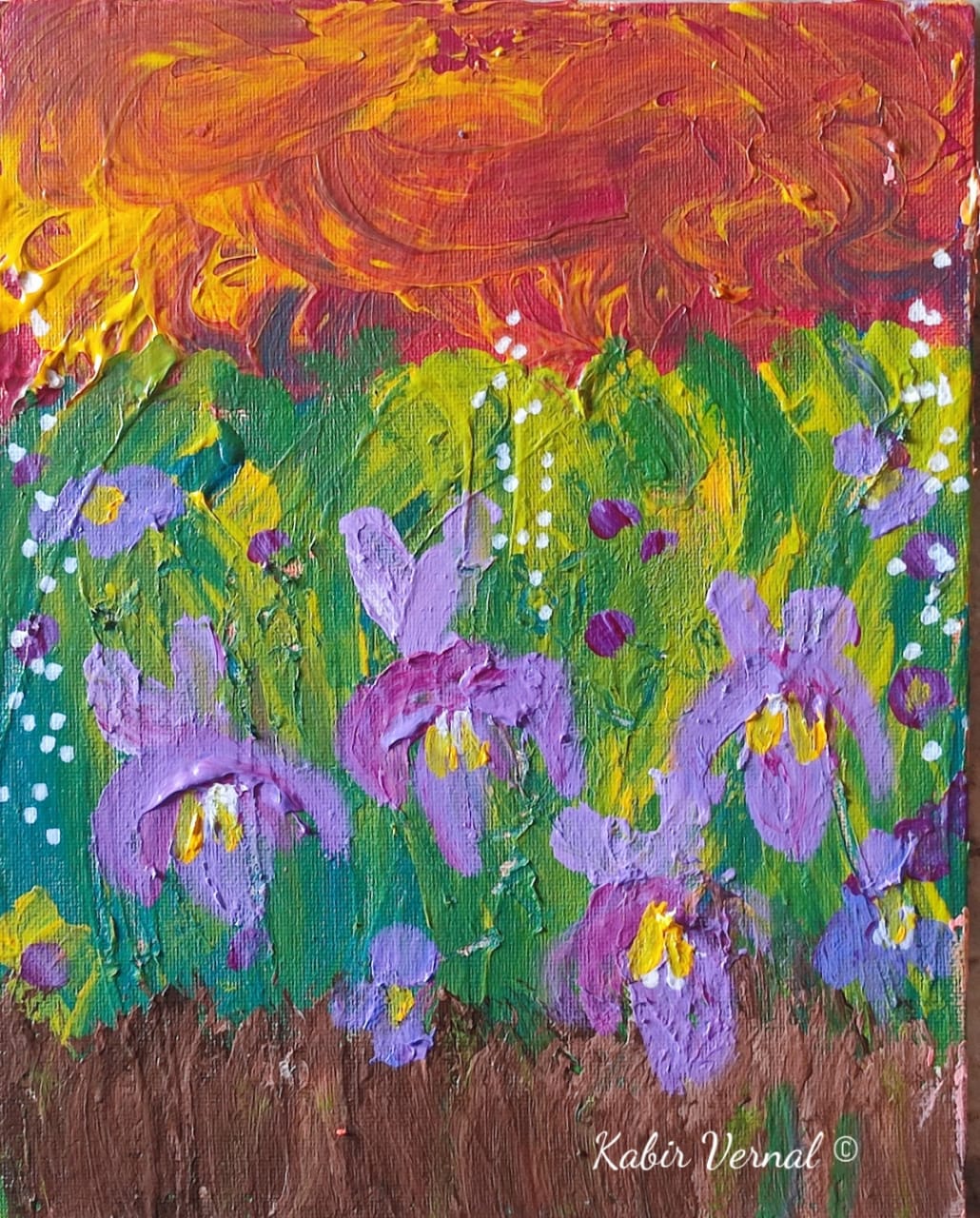
Artwork “Irises and Evening Sky”
Artist Kabir Vernal


Leave a Reply