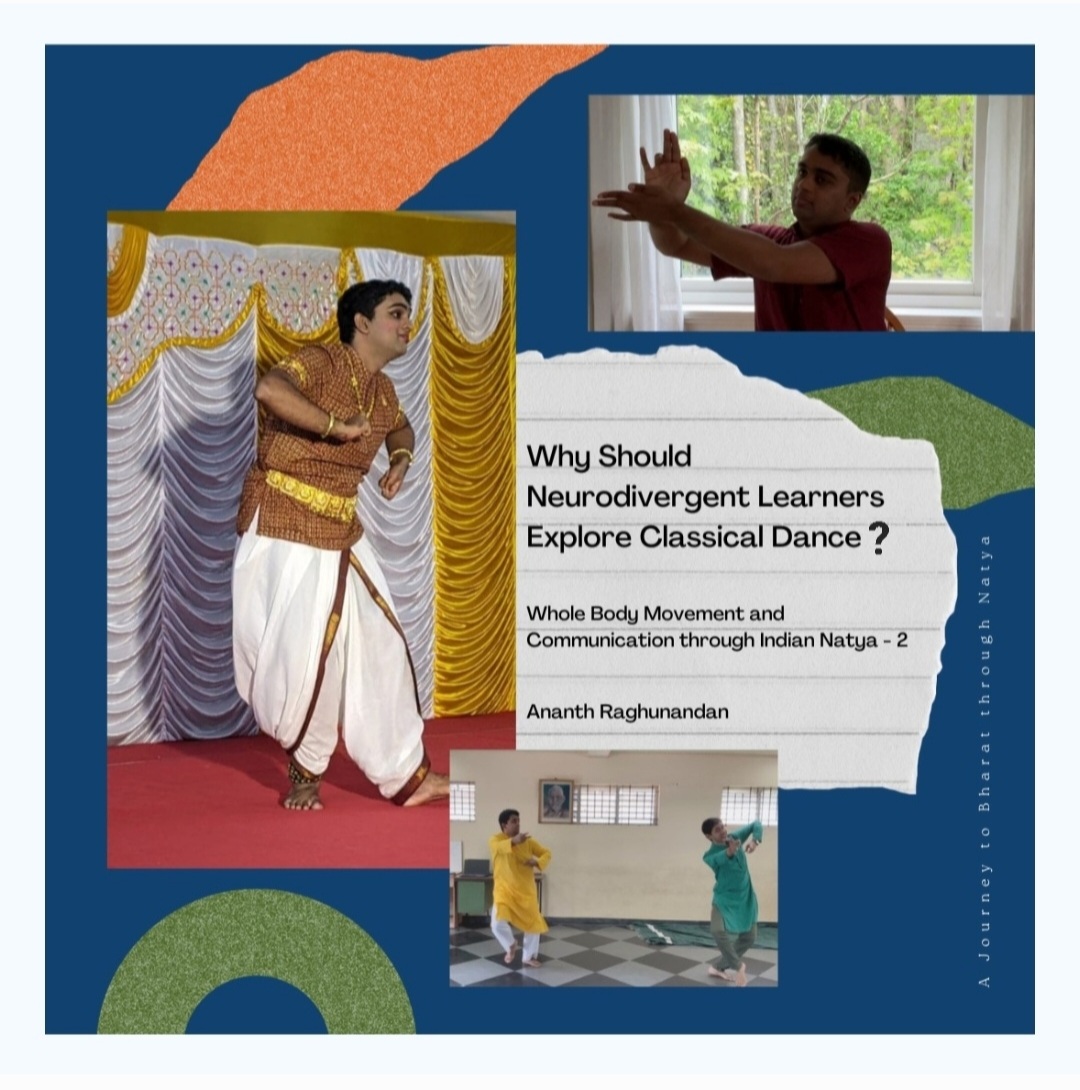
Whole Body Movement and Communication through Indian Natya – 2
Last week, I started writing about whole body movement and communication through Indian natya. While we hear of many neurodivergent learners who sing, play musical instruments, draw, paint, etc., we do not hear much about their dancing. Further, we do not hear much about neurodivergent people and classical dance. One of the questions I am going to be exploring in this series of blog post is:
Why should neurodivergent learners explore classical dance?
Many neurodivergent individuals have significant motor challenges. I did too. When someone has motor challenges, we do not think of teaching them dance. Dr Masgutova, developer of the Masgutova Neurosensorimotor Reflex Integration (MNRI), suggested that I learn dance. I started learning dance in September 2011.
I started my dance journey with hip hop and tap. When we were in Tirupati, I saw a Bharatanatyam performance for the first time and wanted to learn it. Once I started Bharatanatyam, I discovered that I enjoyed Bharatanatyam better than hip hop and tap. Bharatanatyam was taught in a very structured and systematic way which made it easier for me to learn.
Three components of Bharatanatyam lessons that make it easier for me learn the dance form are:
1. Adavus
2. Hastas
3. Bedas
Adavus: Adavus are structured patterns of movement that are the foundation of Bharatanatyam learning. When we start learning Bharatanatyam, we focus on the adavus. Adavus are movement patterns that are done to rhythm. We do the adavus to three speeds. We continue to practice adavus even when we become more experienced students.
Practicing these adavus makes it easy to learn different pieces because the choreography builds on these adavus.
View this playlist to see some lessons on adavus by my teacher Sri Ujwal Jagadeesh, senior faculty for learning (Ramana Maharshi Center for Learning).
https://youtube.com/playlist?list=PLqFzR-vYU-ZilCqKnBaBpxrU_zzprOunQ&si=S_7_Xl5CbIbDIpUq
Hastas
Hastas are hand gestures. Hastas are a unique feature of Bharatanatyam training and performance. We use hand gestures and facial expressions for communicating emotions. In my diploma program, I am learning 52 hand gestures (28 single hand and 24 double hand gestures). Each hand gesture can be used in many ways. I am learning these 52 hastas and their usage.
In TAHD (Theater Arts for Holistic Development), storytelling is one of the tools that is combined in my dance class. We are taught stories for each hasta. This is a unique feature of my TAHD dance class. I did not do such stories when I was learning Bharatanatyam before my arangetram.
See The White Peacock Story and Robbers in Ramana Thatha’s ashram in my storytelling playlist
Watch the White Peacock story with the hasta here.
https://youtu.be/ytnZTB3PRz4?si=rqt6TPuobHciNhs2
Bedas
In addition to adavus and hastas, we also learn bedas. Bedas focus on movements of specific body parts. For example, three bedas that I have learned are:
1) Pada Bedas (movements of the feet)
2) Shiro Bedas (movements of the head)
3) Dhrishti Bedas (movements of the eyes)
These bedas are a systematic way to practice movements of specific body parts and to develop body awareness. For example, Pada Bedas make me more aware of foot positions and movements.
See a playlist of bedas videos here:
https://youtube.com/playlist?list=PLqFzR-vYU-Zie54SRJJBqWDORT4K65lXx&si=VPY1h1_YbDLZvUlz
Classical dance has been a wonderful learning opportunity for me. I am grateful to my gurus Smt. Harija Sivakumar, Professor Kalakshetra Mohanan, and Sri Ujwal Jagadeesh for teaching me Bharatanatyam for many years. The structured and systematic way of learning and practice works well for me. Adavus, hastas, and bedas are three building blocks of Bharatanatyam. By practicing these building blocks regularly, I can learn the dance pieces more easily. I encourage neurodivergent students and their parents to explore classical dance.
Writing Techniques
In my blog posts, I will also mention the writing techniques that I used. Writing is a very important skill and I hope parents will explore these techniques with their children.
I used the five paragraph essay to write this blog post. I practiced this technique daily when I was learning grammar and writing using Shurley grammar.
Shurley Grammar Website
http://www.shurley.com
Celebrating my Birthday: The TAHD Way
On my last birthday in 2022, I narrated the story of The White Peacock on SpecialSaathi. That experience led to the development of my story of the month project and the Ananth’s Adventures Youtube channel.
I will be doing a session for SpecialSaathi on my birthday on December 2, 2023, 8 pm IST. Hope you will join the session on whole body movement and communication with Indian natya!

About Ananth
Ananth Raghunandan is a student ambassador for (Ramana Sunritya Aalaya) RASA and Theater Arts for Holistic Development (TAHD). Ananth Raghunandan is doing a diploma in Bharatanatyam.

Leave a Reply