Triveni Goswami Vernal
Registered Special Educator (CRR A64010)
The previous blog provided an overview of what Gestalt Language Processing is, the various stages and the sources that can be referred to, to understand the origin and context of the phrases used. This blog, will look at how AACs can be used for Gestalt Language Processors.
All AACs basically target the use of Core and Fringe words. Core words are “high frequency” words that comprise of pronouns, verbs, prepositions etc., (for example, I-name, you, put, want, need, help, stop, big, come, drink, eat, happy etc) that make the base of most of the communication. Whereas, fringe words are those that are low-frequency, pertaining to specific interests and topics, that provide a context to the usage of the core words (for example, pizza, juice, family members, toys, clothes etc). So, communication via an AAC would involve a mix of Core and Fringe words.
According to a module on AAC Assessment for GLP (in the AAC+Gestalt Language Processing course available on the Meaningful Speech website http://www.meaningfulspeech.com), “Four characteristics of an AAC Gestalt Language Processor are:
a) Echolalia with a device
b) Scripting with a device
c) Overgeneralized motor patterns with a device
d) Decreased flexibility of words across contexts”.
HOW TO PROGRAM THE GESTALTS IN THE AACs?
Once we can identify the various Gestalts being used by the individual, we can make a folder on the device, for them. The module on “Programming Gestalts in AAC” (in the AAC+Gestalt Language Processing course available on the Meaningful Speech website http://www.meaningfulspeech.com), states the following,
“Many GLPs gravitate to media, as they can listen to it again and again, processing and storing the intonation-rich language that media often provides for later use. Some GLPs may even use media as a form of AAC using a section of a song or show to communicate their thoughts or make observations”.
Therefore, it is suggested, that, the audio or video source of the gestalt in use, is programmed into the device. If the source is not known, the whole gestalts can still be added in the folder, and a context can be given (if that is known). The various resources for the origin of the media that one can look into are—Yarn, Subzin, Play Phrase etc.
Some considerations to keep in mind while choosing which Gestalts to program in the AACs,
“Is the language easily mitigated, versatile, and AAC user driven?
What is the path to stage 3? How can the mitigation be broken down?
Considering gestalts that are needed for efficiency/safety: e.g. I’m finished, Let’s go, My name is ____ “ (Accessed from the module on “Programming Gestalts in AAC” under the AAC+Gestalt Language Processing course available on the Meaningful Speech website http://www.meaningfulspeech.com).
HOW I HAVE CREATED A FOLDER FOR THE GESTALTS IN MY CHILD’S AAC DEVICE
I have created a folder with some common phrases he uses quite often, in the Avaz app. Some of them are phrases he has picked up from the environment, hearing others speak, others have been mitigated to include a specific context. Some examples,
“Put it on” -Put the Wifi on” –‘Put Alexa on”
“Oh Dear”
“Thank you Mama”- “Thank you Mama for the Ice Cream”
“I want to listen to Alexa please”-“I want to watch TV please”
“Did you have fun?” (he tends to say this as a response to the question if he enjoyed an outing)
‘I am sorry’
“Do not disturb” –Do not disturb when Mama is speaking
“I love you’
“Kabir is a good boy” /“Kabir is a cute boy” (extensively used by him whenever he is being very mischievous and he gets caught doing something he shouldn’t be doing 😊)
‘Feeling Good’
“Its so hot’
“Good Waiting”
‘Its not okay”
He doesn’t use the AAC every day, but the folder has been made to get him to practice some of these phrases from time to time. Or even when I feel, he is confused about something, and needs a space to be able to express his thoughts with greater clarity. The folder is not static…there are new phrases added to it, across time.
REFERENCES:
https://www.meaningfulspeech.com/blog/misconceptions-aac-glp
https://www.vantatenhove.com/files/papers/VocabularyLists/CoreVocabularyClassroomChecklist.pdf
https://www.meaningfulspeech.com/blog/misconceptions-aac-glp
https://www.assistiveware.com/learn-aac/learn-about-core-word-teaching-strategies#
https://www.fluentaac.com/fringe-words
https://theautismhelper.com/core-and-fringe-vocabulary-what-it-is-how-to-use-it/
https://www.communicationcommunity.com/core-vs-fringe-words/
https://praacticalaac.org/praactical/fringe-vocabulary-how-to-select-and-not-neglect/
***********
Dr.Triveni Goswami Vernal is a Registered Special Educator (CRR: A64010), a Psychologist and an Expressive Arts Therapy Practitioner (UNESCO-CID). She is an Avaz Certified Educator and Certified in Dyslexia Teacher Training. She is also an art educator for children with additional needs. She has a 14 year old on the Autism spectrum. She is presently working as a Consultant Special Educator at Oyster CDC, Begumpet, Hyderabad.
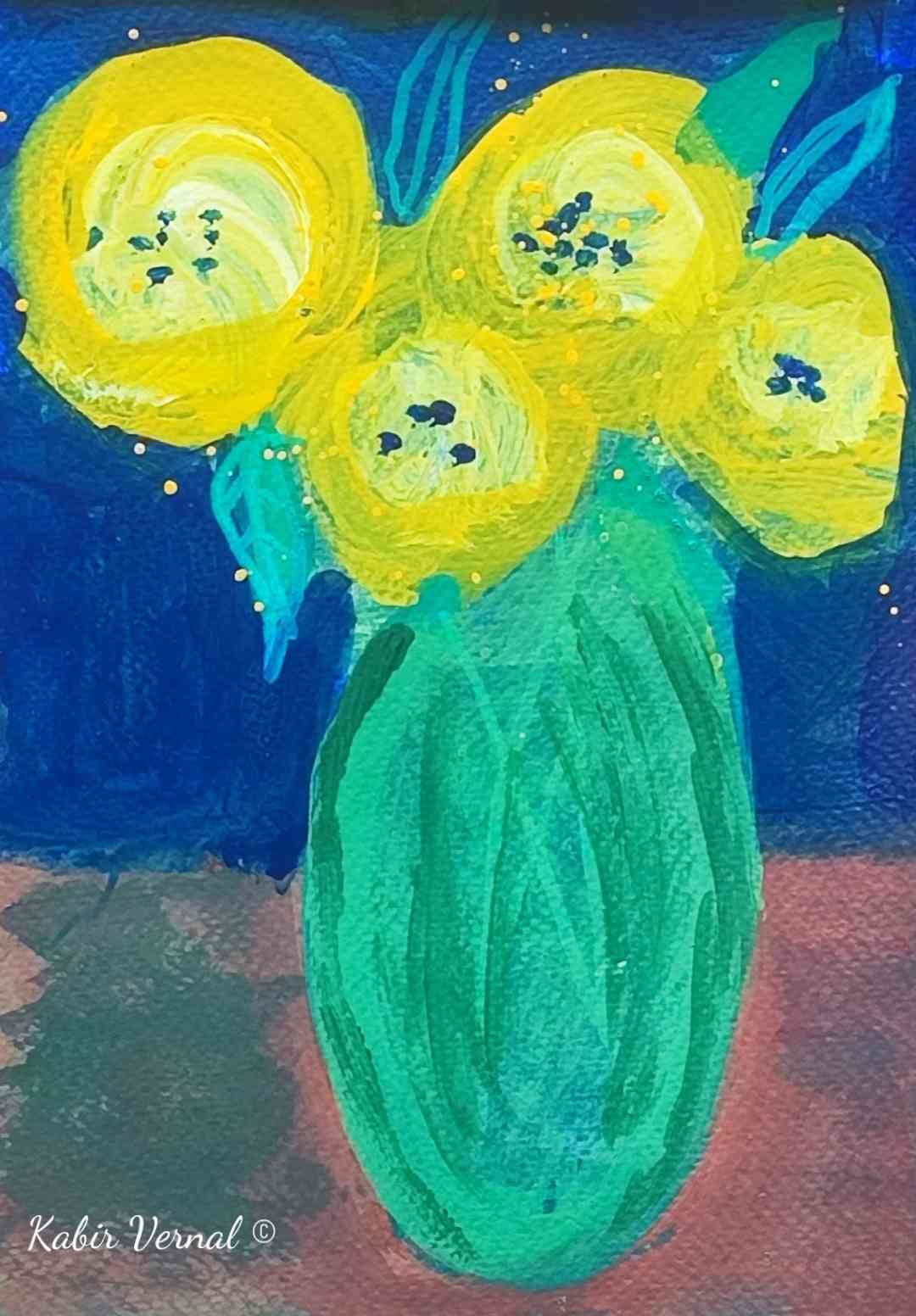
“Yellow Anemones in a Vase”
Acrylic Painting on Watercolour Paper
Kabir Vernal
Leave a Reply