Triveni Goswami Vernal
Registered Special Educator (A64010)
In the natural world, Penguins (especially two species, Adelie and Gentoo) are known to present smooth pebbles used for nest building to their partner as part of their courtship display (https://en.wikipedia.org/wiki/Pebbling). In humans too, one can see evidence of “pebbling” when they send gifts, or engage in actions that convey to the other, that they were in their thoughts. In the digital world, the act of sending memes or videos, to maintain social connection, can be labelled as pebbling. And that is something, a lot of us engage in, in our daily lives.
In the neuro-diverse world, “pebbling” can often be seen in individuals with Autism and ADHD who express their desire for social connection by sharing things they like/information, videos or small tokens of affection. It is a form of non-verbal or non-speaking communication.
While “digital pebbling” is an accepted social norm in the neurotypical world, that most of us engage in, quite frequently, it is rather sad to see how other forms of non-speaking communication, such as via AACs (Alternative and Augmentative Communication), that are an essential means of communication for innumerable individuals on the Autism Spectrum, are met with suspicion and disdain.
An unfounded fear that a lot of parents and caregivers have towards the usage of AACs is that the child would stop using words or stop making an effort to speak, if they only communicated via AAC devices, communication boards, visual supports, letterboards/ sign language/gestures/ PECS etc. But that is far from the truth. Research has consistently shown that, the use of AACs provides individuals with:
a) Access to Communication (ability to express their emotions, feelings, body pain, needs, special interests etc)
b) Acquisition of Vocabulary (new words and phrases)
c) Opportunities for Peer interaction and Social Inclusion (play games, have shared interests etc)
d) Individualized /Customized Academic support
e) Opportunities to pursue leisure activities etc.
These are just some of the benefits. The sooner we introduce AACs along with other interventions, the better it is, for the individuals with additional needs. Imagine, not having access to alternative tools of communication…that would lead to immense frustration and anger. Introducing an AAC is a win-win for both the individual with additional needs as well as the caregiver.
The next blog will look at various forms of non-speaking and minimally speaking communication, including Gestalt Language Processors.
REFERENCES:
https://earlyautismventures.in/importance-of-augmentative-and-alternative-communication-aac-in-speech-therapy-and-pathology/
https://www.asha.org/public/speech/disorders/aac/?srsltid=AfmBOorpeqQANYfyIz1tXBhDM4gSgz7H5jOAFH5L1b2y-b402S4gPLWR
https://pmc.ncbi.nlm.nih.gov/articles/PMC4017351/
https://www.asha.org/public/speech/disorders/aac/
https://pubmed.ncbi.nlm.nih.gov/37017363/
https://pmc.ncbi.nlm.nih.gov/articles/PMC4017351/
https://commons.emich.edu/cgi/viewcontent.cgi?article=1744&context=honors
https://pmc.ncbi.nlm.nih.gov/articles/PMC5036660/
**************
Dr.Triveni Goswami Vernal is a Registered Special Educator (CRR: A64010), a Psychologist and an Expressive Arts Therapy Practitioner (UNESCO-CID). She is an Avaz Certified Educator and Certified in Dyslexia Teacher Training. She is also an art educator for children with additional needs. She has a 14 year old on the Autism spectrum. She is presently working as a Consultant Special Educator at Oyster CDC, Begumpet, Hyderabad.
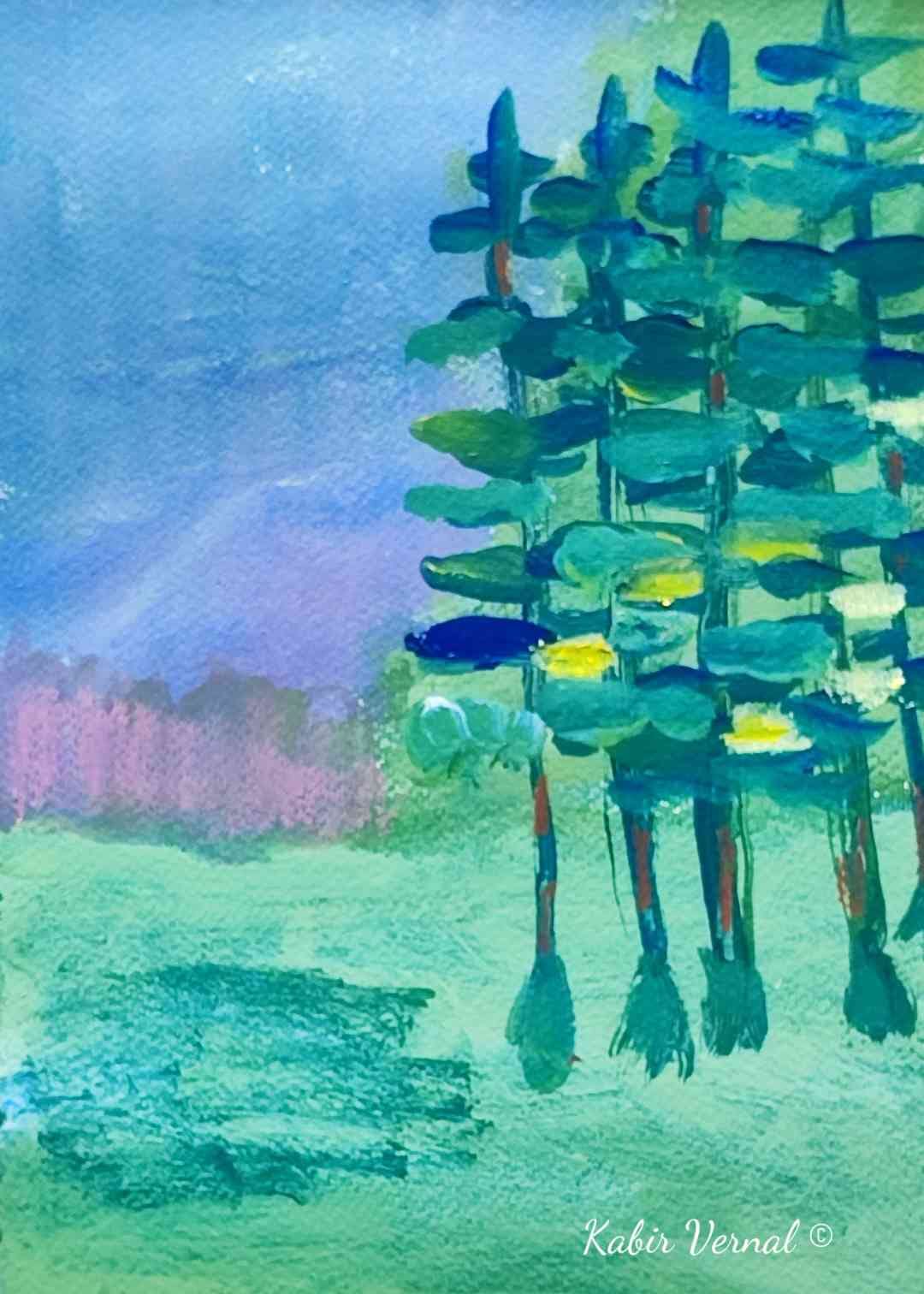
“Forest”
Acrylic Painting on Watercolour Paper
Kabir Vernal
Leave a Reply