Triveni Goswami Vernal
Registered Special Educator (A64010)
Individuals on the Autism Spectrum may not always be able to gauge an appropriate “personal space” while interacting with others. To put it simply, ‘personal space’ refers to the physical distance that an individual maintains when interacting with others. Sometimes, individuals on the spectrum may stand too close to others, or they may touch the bodies of other individuals (tap their arm or go close to their face and explore a face mask or a head cover etc), without the consent of the other.
When a child is younger, such intrusion into personal space is usually brushed off by the other individual. But as the individual on the spectrum grows older and they become more aware of their bodies in time and space, they need to be taught about personal space and the “dos and dont’s” / norms of social interaction. This also becomes significant to prevent abuse in any form, by the other individual.
HOW DO WE TEACH THE CONCEPT OF PERSONAL SPACE?
A commonly used Visual tool to teach ‘personal space’, to individuals on the Autism spectrum, is the “Circle of Trust”.
The Circle of Trust visual tool comprises of several concentric circles that depict the various layers of personal boundaries and the kind of social interactions, that one can form for each of those layers. At the very centre of the circle, is the individual on the Autism Spectrum, the next circle comprises of the Immediate family, then Extended family and friends, then Professionals (like doctors, teachers etc) and the very last circle comprises of Strangers.
Other than creating a Circle of Trust to depict which category of people in the individual’s life would fall within which circle, the visual tool must also include the kind of interaction that can take place for each circle. For example, hug or kiss can be an acceptable form of interaction with the Immediate Family and perhaps Grandparents, hug the extended family and friend, shake hands or a more formal hug with Professionals and Wave/Smile at Strangers.
To be Noted: The nature of accepted interaction within each circle, can be defined and decided by the family and it may vary from one family to another.
AN EXAMPLE OF A ‘CIRCLE OF TRUST’

Source: https://raisingchildren.net.au/__data/assets/pdf_file/0026/94616/Circle-of-friends_rem.pdf
In a nutshell, the Circle of Trust visual support can help individuals on the Autism Spectrum know about the various people in their lives, the “appropriate” social interactions that they can form with other people and it can also create an understanding of issues of safety and trust not only regarding how they should behave with others, but also about how others should behave towards them.
RESOURCES:
https://raisingchildren.net.au/autism/development/sexual-development/circle-of-friends-personal-boundaries-activity-children-3-15-years
https://autismni.org/assets/resources/visuals-and-social-stories/games-and-social/Circle-of-trust-PDF.pdf
https://www.beyondautism.org.uk/resource-hub/supporting-safe-interactions/
*********
Author Dr.Triveni Goswami Vernal
Dr.Triveni Goswami Vernal is a Registered Special Educator (CRR: A64010), a Psychologist and an Expressive Arts Therapy Practitioner (UNESCO-CID). She is an Avaz Certified Educator and Certified in Dyslexia Teacher Training. She is also an art educator for children with additional needs.
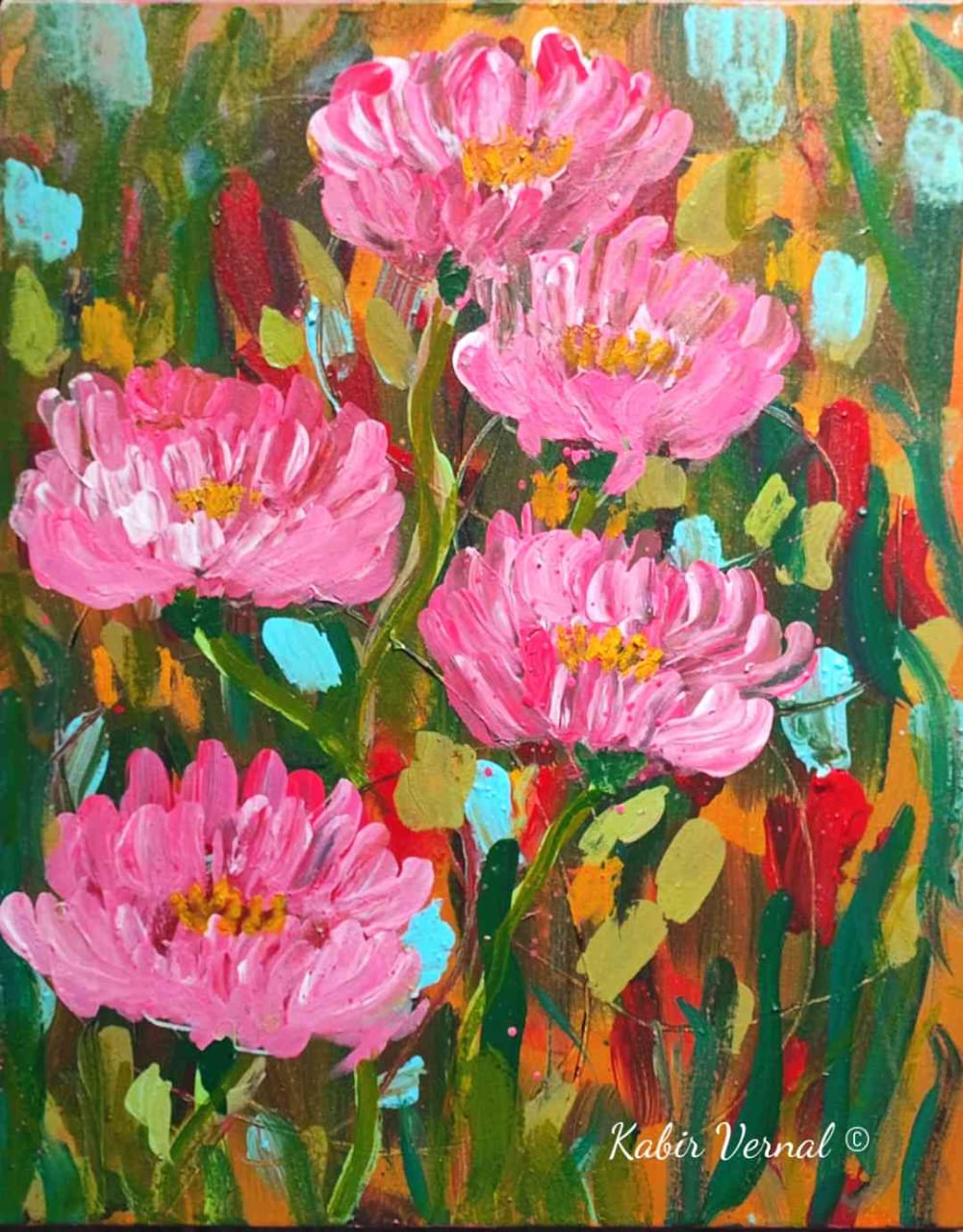
“Peonies”
Artist: Kabir Vernal
Acrylic Painting on Canvas
16 x 20 inches
Leave a Reply